Insights
World Cup 2026: The First AI-Predicted Tournament That Could Change Football Forever
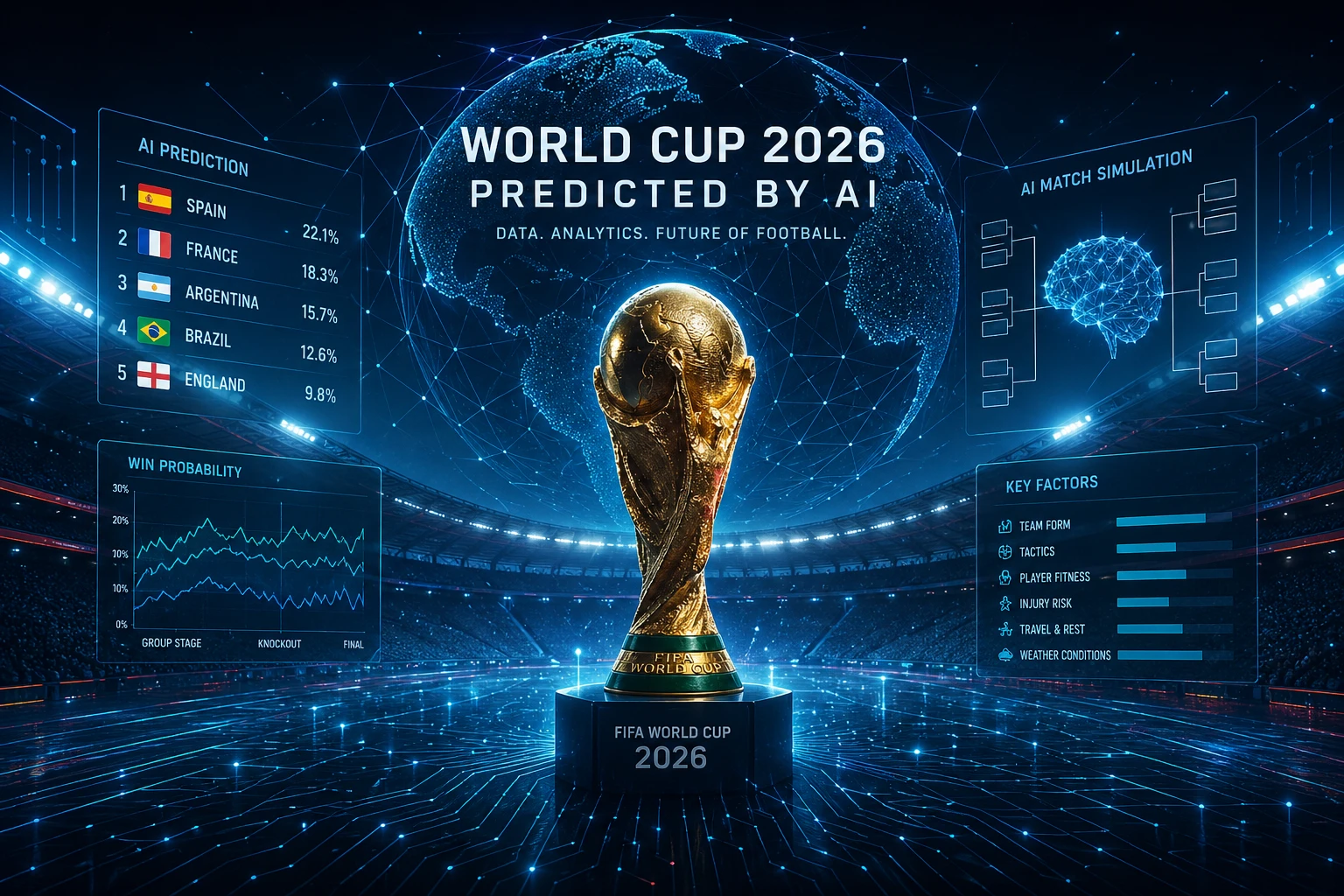
The FIFA World Cup 2026 is not just the biggest tournament in football—it may become the first truly “AI-shaped” World Cup, where data, algorithms, and predictive models influence how fans, analysts, and even teams see the game.
As global anticipation builds for the FIFA World Cup 2026, a quiet revolution is unfolding behind the scenes. For the first time in football history, artificial intelligence is not just analyzing matches—it is actively shaping narratives, influencing fan expectations, and redefining how outcomes are predicted.
This year’s tournament is not only about who wins on the pitch. It is also about whether data can finally outperform instinct.
The Rise of AI in Football Prediction
Over the past decade, AI has evolved from basic statistical tools into sophisticated systems capable of simulating entire tournaments. These models ingest massive datasets, including:
- Player performance metrics across club and international competitions
- Tactical formations and in-game adjustments
- Injury history and fatigue levels
- Weather, travel distance, and match scheduling
Using techniques such as Monte Carlo simulations and neural network modeling, AI systems can run tens of thousands of World Cup scenarios within minutes. The result is not a single prediction—but a probability landscape of outcomes.
And this year, those probabilities are attracting unprecedented attention.
A Tournament Designed for Chaos
The 2026 edition introduces a new 48-team format, increasing both the scale and unpredictability of the competition. More teams mean more variance, and more variance makes prediction harder.
Paradoxically, this is where AI thrives.
While human analysts struggle to account for hundreds of possible matchups, AI systems excel at modeling complexity. Early simulations suggest that:
- Traditional powerhouses still dominate the later stages
- Mid-tier teams have a higher-than-ever chance of reaching quarter-finals
- Upsets in the group stage are likely to increase by 15%–25% compared to previous tournaments
This creates a tournament environment where “surprises” are no longer anomalies—they are statistically expected outcomes.
The New Favorites: Data vs Legacy
Historically, World Cup favorites were determined by reputation, past success, and star players. In 2026, AI is challenging that paradigm.
Data-driven rankings often differ from traditional expectations. Teams with strong underlying metrics—such as passing efficiency, defensive compactness, and transition speed—are being elevated above more famous squads.
For example, AI models consistently highlight the Spain national football team as a leading contender due to its balance of youth and tactical maturity. Meanwhile, reigning champions like the Argentina national football team remain competitive but face statistical headwinds.
This shift signals a broader trend: football is moving from narrative-driven analysis to evidence-based forecasting.
Fans Are Changing Too
Perhaps the most significant impact of AI is not on teams—but on fans.
In previous tournaments, debates were fueled by emotion and loyalty. Today, fans increasingly reference probabilities, expected goals (xG), and simulation outcomes. Social media is filled with AI-generated brackets, predictive dashboards, and consensus forecasts.
A new kind of fan is emerging: one who doesn’t just support a team, but also understands its statistical chances.
This creates a unique dynamic where belief and data coexist—and sometimes conflict.
The Limits of Prediction
Despite its power, AI is not infallible. Football remains a low-scoring sport with high randomness. A single red card, penalty decision, or moment of brilliance can invalidate even the most accurate model.
AI predictions are probabilistic, not deterministic. A team with a 20% chance of winning is still far more likely to lose than to win.
This uncertainty is not a flaw—it is the essence of football.
Why This World Cup Could Go Viral
The convergence of AI and sport creates a perfect storm for global engagement:
- Controversy: When AI predictions contradict popular opinion
- Validation: When predictions come true, reinforcing trust in data
- Debate: When fans argue data vs intuition
- Accessibility: AI tools are now available to everyone, not just analysts
In short, every match becomes more than a game—it becomes a test of intelligence, both human and artificial.
Conclusion: A New Era Begins
The 2026 World Cup may be remembered not just for its winner, but for how it was experienced. For the first time, billions of fans will watch the tournament alongside algorithms that predict every pass, shot, and outcome.
Whether AI proves right or wrong is almost secondary.
What matters is that football has entered a new era—one where the beautiful game is no longer just played on grass, but also computed in code.