Insights
World Cup 2026: All the Records — Tallest, Shortest, Oldest, Youngest, and Every Remarkable Stat You Need to Know
FIFA has officially unveiled the 1,248-player roster for World Cup 2026. From the tallest squad (Bosnia & Herzegovina) to the shortest (Saudi Arabia), the oldest goalkeeper (43-year-old Craig Gordon) to the youngest player (18-year-old Gilberto Mora), and Man City's 19-player contribution — here are all the record-breaking stats ahead of the tournament kicking off on June 11.
The Height Race: Who Stands Tallest at World Cup 2026?
On June 2, FIFA officially released the full squad lists for the 2026 FIFA World Cup — a total of 1,248 players representing 48 nations. Beyond the tactical battles and title contenders, the numbers tell their own fascinating story. From towering goalkeepers to teenage debutants, from aging legends to fresh-faced rising stars, here is a comprehensive breakdown of every standout statistic from this summer's mega-tournament, which runs from June 11 to July 19.
Bosnia & Herzegovina Lead the Way — By a Landslide
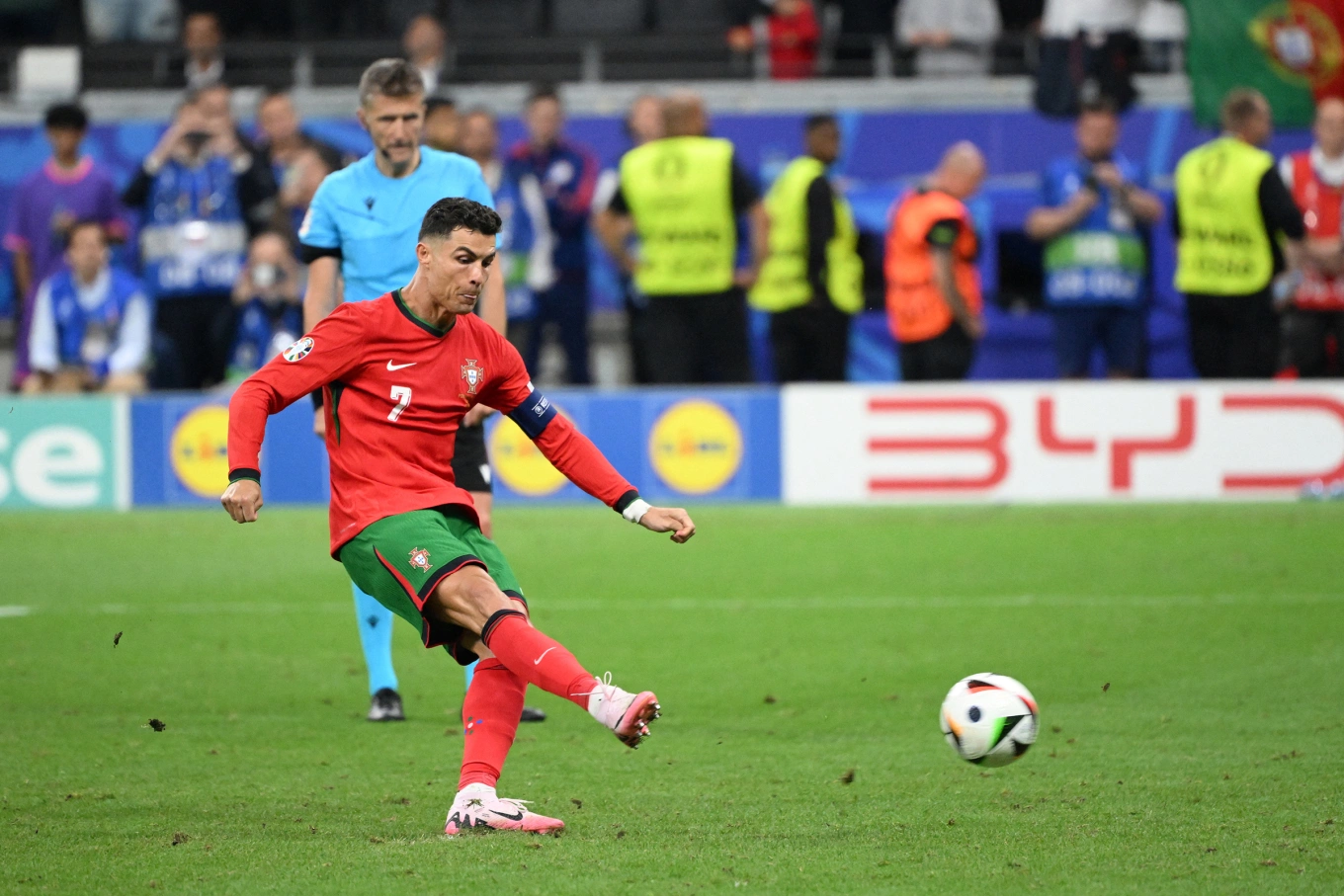
When it comes to sheer physical stature, Bosnia & Herzegovina have no equal at this tournament. The side featuring veteran striker Edin Džeko boasts an average squad height of 1.8723 meters across their 26 registered players — the highest of any nation at World Cup 2026.
Close behind are Norway at 1.8715m and Sweden at 1.8619m, making this a decidedly Scandinavian and Balkan affair at the top of the height charts.
The broader trend is clear: Northern and Central European nations dominate the upper echelons. Belgium, Czech Republic, Germany, and Switzerland all feature in the Top 7, confirming that this region consistently produces players with imposing physical frames.
The Title Contenders: Where Do France, Netherlands, and Argentina Rank?
Perhaps surprisingly, two of the most heavily fancied title contenders sit much further down the list. Both France and the Netherlands share an identical average height of 1.8492 meters, placing them joint 8th in the rankings — impressive in absolute terms, but a full 2.3 centimeters shorter than the Bosnians.
More striking still is the case of defending champions Argentina. Messi's men rank just 44th out of 48 nations with an average height of only 1.7969 meters — nearly 8 centimeters shorter than World Cup 2026's tallest squad. It's a reminder that in football, as Argentina have proven repeatedly, height is no prerequisite for greatness.
The Shortest Squads: Asia and Africa at the Bottom
At the other end of the spectrum, the shortest squads are predominantly from Asia and Africa. Saudi Arabia hold the unwanted distinction of being the shortest team in the tournament, averaging just 1.7842 meters. They are followed by South Africa (1.7885m), Qatar (1.7938m), and Mexico (1.7950m).
The Individual Extremes: Who Is the Tallest — and Shortest — Player?
Austria's Giant Between the Posts
The tallest individual at World Cup 2026 is Florian Wiegele, goalkeeper for Austria, who stands at a remarkable 2.05 meters (6 feet 8.7 inches). He is joined near the top by Bosnia & Herzegovina defender Stjepan Radeljić and Colombia goalkeeper Álvaro Montero, both measuring in at 2.01 meters.
It comes as no surprise that goalkeepers dominate the Top 10 tallest players list, alongside a handful of commanding strikers and central defenders such as Saša Kalajdžić, Tomáš Chorý, and Harry Souttar.
Panama's Pocket Rocket
At the opposite extreme, Panama midfielder César Yanis is the shortest player at World Cup 2026, standing at just 1.60 meters (5 feet 3 inches). The difference between Yanis and Wiegele is a staggering 45 centimeters — illustrating the astonishing physical diversity that the expanded 48-team tournament brings to the global stage.
The Age Factor: Which Teams Are Playing It Old — and Which Are Going Young?
Iran Lead the Veteran Nations
If height belongs to Bosnia, then age belongs to Iran. The Asian side are the oldest team at World Cup 2026, with an average squad age of 30.46 years. They are followed by Colombia and Panama, both averaging 30.38 years — making all three teams above the 30-year threshold, a notable sign that experience still commands trust in international football.
Qatar, Scotland, and Brazil also feature among the six oldest squads, with average ages ranging from 29.27 to 29.58 years.
Defending champions Argentina sit in 9th place overall with an average age of 29.04, while Uruguay appears in the top 12 oldest squads at 28.81 years.
The data points to a broader philosophy: even in 2026, many national team coaches still prefer battle-tested veterans over the excitement of youth.
The Youngest Teams: Africa Leads the New Generation
On the other side of the demographic spectrum, Ivory Coast (Côte d'Ivoire) are the youngest team at World Cup 2026, with an average squad age of just 25.92 years. Ecuador follow at 26.08, while the surprising Bosnia & Herzegovina create a fascinating paradox — they are simultaneously the tallest team and one of the youngest squads at the tournament, averaging just 26.42 years.
Morocco (26.46) and Tunisia (26.65) round out a strong North African presence among the youthful nations. Even Spain, traditionally known for blooding young talent, ranks 43rd on the age table with an average of just 26.73 years — a testament to their long-standing commitment to attacking, dynamic football.
The Oldest and Youngest Players: Legends and Newcomers Under the Same Spotlight
Craig Gordon, 43 — Oldest Player in the Tournament
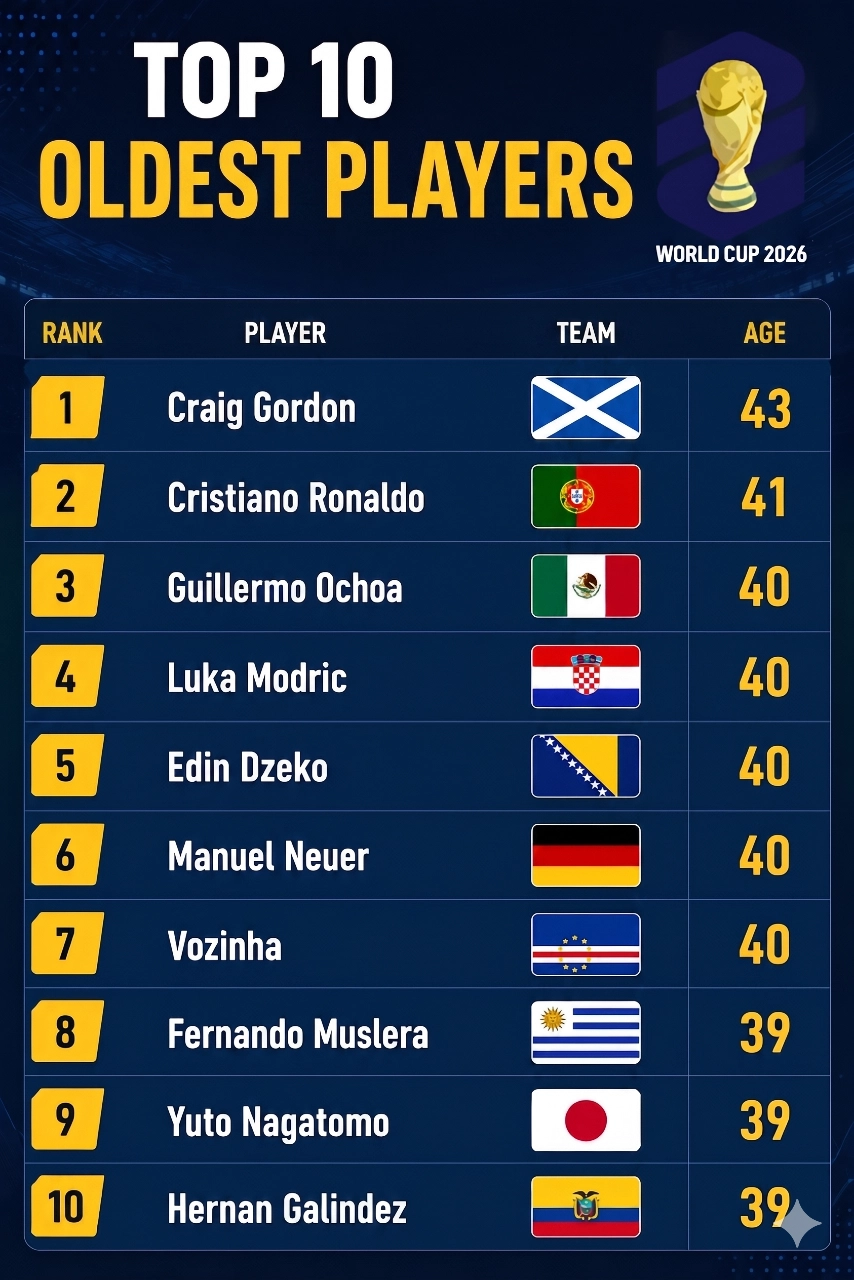
The oldest player at World Cup 2026 is Craig Gordon, Scotland's veteran goalkeeper, who is 43 years old. He edges out none other than Cristiano Ronaldo — who, at 41, is the second oldest player in the entire tournament.
Let that sink in: Ronaldo, widely considered one of the greatest players in football history, is not even the oldest player at a World Cup he's attending as one of his nation's key figures.
Elsewhere in the upper age bracket, Guillermo Ochoa (Mexico), Luka Modrić (Croatia), Edin Džeko (Bosnia & Herzegovina), and Manuel Neuer (Germany) have all crossed the 40-year threshold. Meanwhile, Lionel Messi, at 39 years old, just misses the Top 10 oldest players — though his mere presence is a story in itself.
A remarkable pattern emerges from the top 10 oldest players: 6 of them are goalkeepers. This reflects the unique nature of the position — one that relies far less on explosive pace and raw athleticism, and far more on experience, reading the game, and shot-stopping technique that only years of elite football can develop.
Gilberto Mora, 18 — The Youngest Player in the Tournament
At the other end of the timeline, Gilberto Mora of Mexico is the youngest player at World Cup 2026, aged just 18 years old. Born in October 2008, the young midfielder entered the world barely two months before Cristiano Ronaldo claimed his first Ballon d'Or.
The generational gap between Mora and Craig Gordon is an astonishing nearly 26 years — a gap that perfectly encapsulates the extraordinary span of talent on display at this tournament.
Mora is not alone in representing the 2007–2008 birth year cohort. Other teenage talents at World Cup 2026 include Hugo Sochurek (Czech Republic), Lennart Karl (Germany), Ibrahim Mbaye (Senegal), and Ayyoub Bouaddi (Morocco) — names that may well define the next decade of world football.
Club Representation: Which Teams Are Sending the Most Players?
Manchester City Top the Table
On the club front, Manchester City lead all clubs with 19 players at World Cup 2026 — the most of any single club in the tournament. Bayern Munich follow with 18 representatives, and Arsenal and PSG — the two finalists of the 2025–26 UEFA Champions League — each contribute 16 players.
The most surprising entry in the Top 5 is Crystal Palace, who match Manchester United and Al-Hilal with 12 players each — a remarkable achievement for a club that has not traditionally been considered among Europe's elite.
Leagues: The Premier League Reigns Supreme
When it comes to domestic leagues, the English Premier League sends more players to World Cup 2026 than any other competition, with 163 participants. The Bundesliga is second with 101, followed by La Liga (81), Ligue 1 (80), and Serie A (62).
The Saudi Pro League has cemented itself as a genuine destination for world-class talent, contributing 47 players — while MLS, the host nation's league, sends 44 of its own to what promises to be North America's greatest-ever football spectacle.
Why These Numbers Matter
The statistics surrounding World Cup 2026 tell a story far richer than mere data points. They speak to the democratization of global football, where a nation as compact as Panama can field a midfielder 45 centimeters shorter than a 2-meter Austrian goalkeeper; where a 43-year-old Scotsman and an 18-year-old Mexican can share the same pitch; where a club from South London can supply as many World Cup players as Manchester United.
From June 11 to July 19, across stadiums in the United States, Canada, and Mexico, these 1,248 players — tall and short, veteran and rookie, from the biggest clubs and the smallest nations — will compete for the most coveted prize in world sport.
The records have been set. Now it's time to play.