
AI Tools
Stop Asking One AI When You Can Ask 10: The Future of Smart Decision-Making
What if instead of trusting one AI's opinion, you could instantly poll 10 of the world's most powerful models — ChatGPT, Claude, Gemini, Mistral, DeepSeek, and more — at the same time? TuringStats' Ask Multiple AIs feature does exactly that, giving you a consensus vote, individual reasoning, and unmatched confidence in your decisions.
You've just made a major decision — maybe about an investment, a career move, a business pivot, or even who's going to win the World Cup. You turned to an AI for a second opinion. It gave you one. But here's the question that should keep you up at night: what if that single AI was wrong?
AI models are remarkably powerful — but they're not infallible. Each one has unique training data, biases, strengths, and blind spots. ChatGPT may lean optimistic. Gemini might weigh different variables. Claude tends to reason with caution. DeepSeek thinks from a different vantage point entirely. The truth is, no single AI has a monopoly on being right.
That's the problem TuringStats solves with its groundbreaking Ask Multiple AIs feature — and once you try it, you'll never go back to asking just one.
What Is the Ask Multiple AIs Feature on TuringStats?
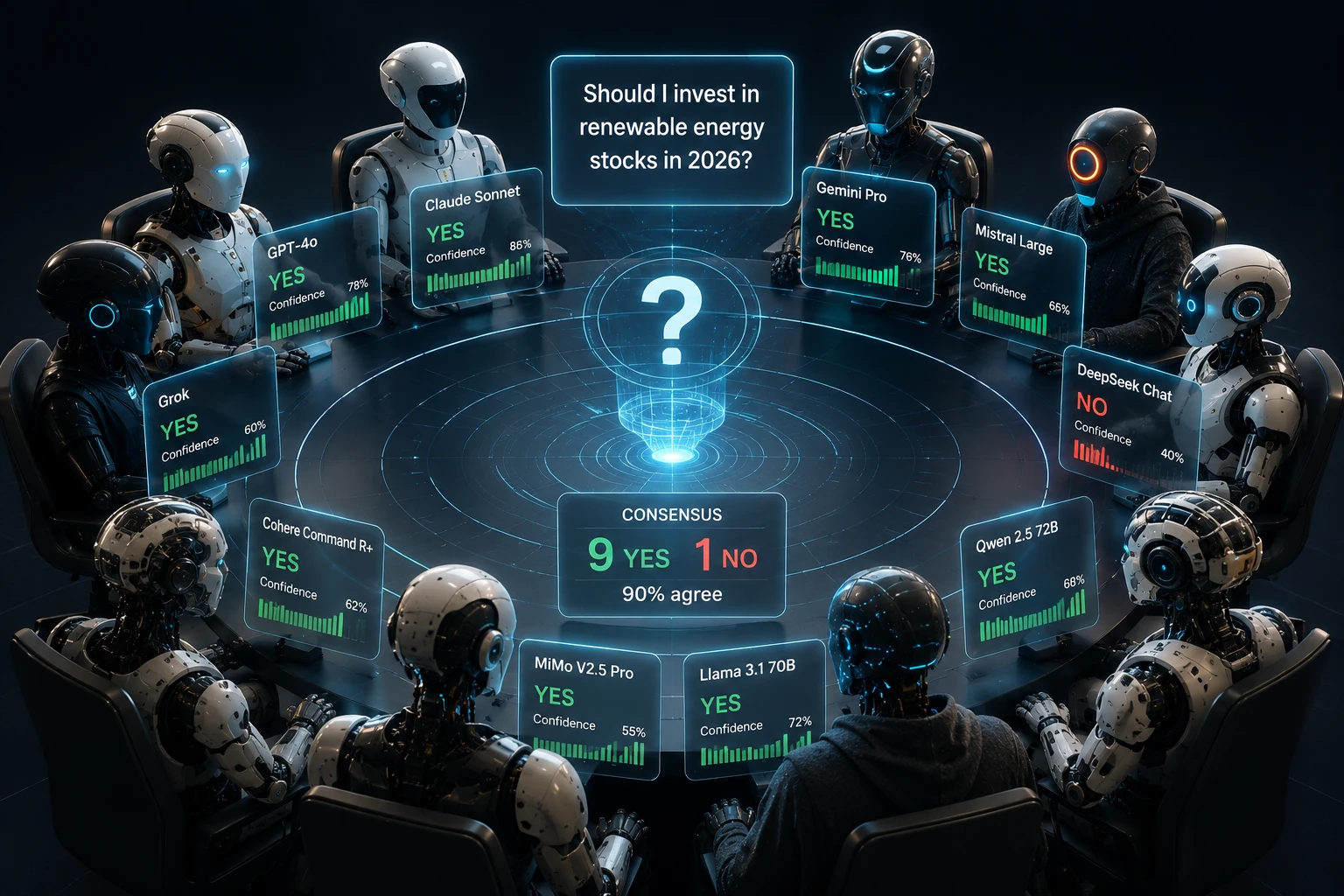
Imagine convening a panel of the world's 10 smartest AI experts in one room and asking them the same question simultaneously — then watching each one vote yes or no and explain their reasoning. That's exactly what TuringStats' Ask Multiple AIs feature does, and it's as powerful as it sounds.
Called the "AI Council," this feature on TuringStats lets you submit a single yes/no question and instantly receive responses from 10 frontier AI models running in parallel. The panel includes GPT-4o, Claude Sonnet, Gemini Pro, Mistral Large, DeepSeek Chat, Qwen 2.5, Llama 3.1, MiMo, Cohere Command R+, and Grok — the exact same roster of models that powers TuringStats' renowned match forecasts. Each model receives the identical prompt with no prior knowledge of what others voted, ensuring genuine, unbiased perspectives.
You get a clear consensus vote — how many models agreed, how many disagreed — plus each model's individual reasoning that you can actually read and evaluate. Results typically arrive within 1 to 3 minutes as the models run automatically in the background with built-in retries.
Why Asking One AI Is Not Enough Anymore
We live in the golden age of artificial intelligence, yet most people still consult AI the way they'd ask a single friend for advice. You type your question into ChatGPT. It answers. You accept it. But that approach has a fundamental flaw: you're getting one perspective from one model trained on one particular set of data with one particular set of tendencies.
Consider how humans make great decisions: we consult multiple experts. We get a second opinion from another doctor. We ask several financial advisors before investing. We survey friends, read multiple reviews. The wisdom of crowds — that collective intelligence consistently outperforms individual judgment — is one of the most well-documented phenomena in decision science.
TuringStats has applied exactly this principle to AI. Instead of asking one model, you ask ten — all at once. The result isn't just more data; it's smarter, more reliable insight.
How the AI Council Actually Works: Step by Step
Step 1: Frame Your Question
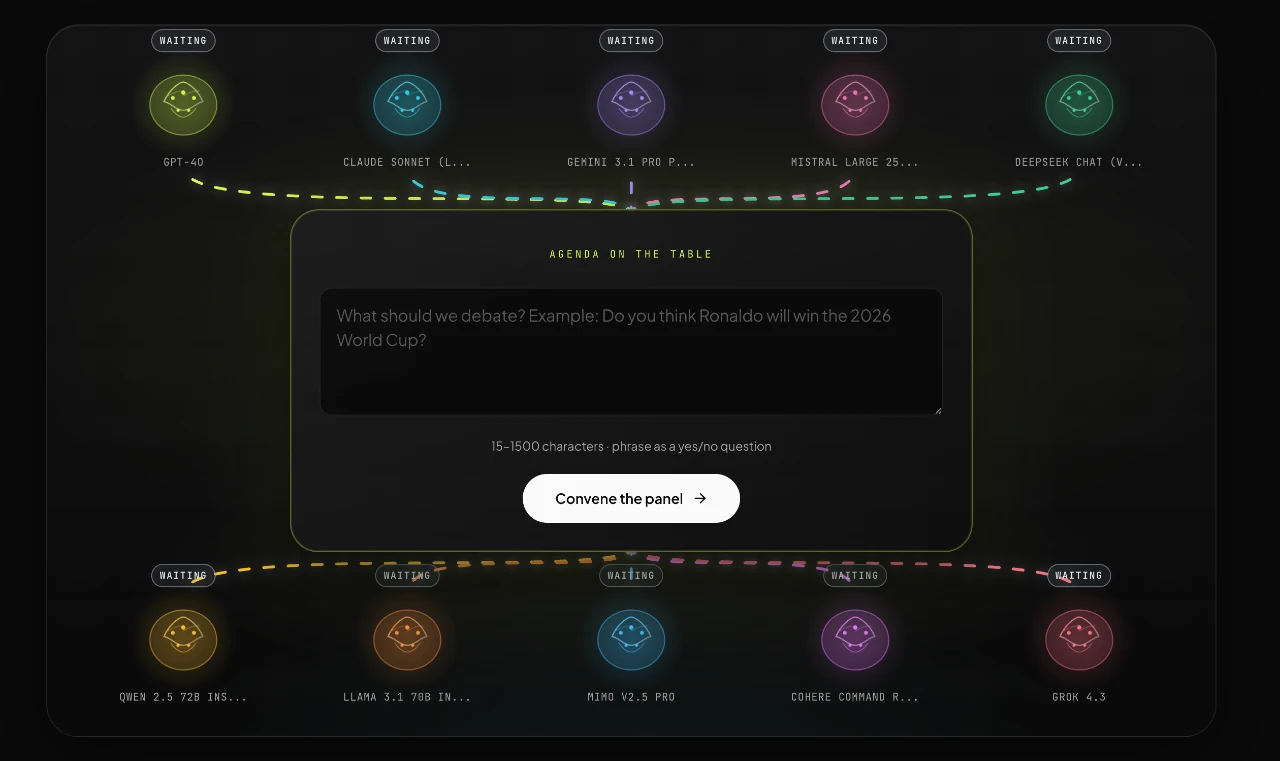
Navigate to the Ask Multiple AIs page on TuringStats. You'll see the AI Council panel waiting for you. The only requirement: your question must be answerable with a clear yes or no. This binary format is the secret sauce — it forces every model to take a definitive stance rather than hedging with vague answers. Questions can be 15 to 1,500 characters long.
Step 2: Convene the Panel
Hit "Convene the Panel" and watch the magic happen. All 10 models receive your prompt simultaneously, with no ability to peek at each other's answers beforehand. This is critical: it ensures each model's vote reflects its own independent reasoning, not groupthink.
Step 3: Read the Verdict
Within minutes, you'll see the consensus vote — a clear scorecard like "7 agree, 3 disagree" — plus each model's written explanation. You can read exactly why GPT-4o voted yes while Mistral voted no, which is often just as valuable as the vote itself. Understanding the reasoning behind disagreements is where the real insight lies.
Meet the 10 AI Models on the Council
Not all AI models are created equal, and TuringStats doesn't pretend otherwise. The council is deliberately diverse — spanning different architectures, training approaches, and knowledge bases. Here's who's on your expert panel:
GPT-4o — OpenAI's flagship multimodal model, renowned for nuanced reasoning and broad general knowledge. Claude Sonnet (Latest) — Anthropic's safety-focused model, particularly strong at careful, step-by-step analysis. Gemini Pro — Google's frontier model with strong factual grounding and real-world data capabilities. Mistral Large — Europe's leading open-weight model, celebrated for efficiency and sharp analytical reasoning. DeepSeek Chat — China's breakout AI, praised for logical depth and technical insight. Qwen 2.5 72B — Alibaba's powerful open-source model with strong multilingual and reasoning capabilities. Llama 3.1 70B — Meta's open-source powerhouse, democratizing frontier AI performance. MiMo V2.5 Pro — A rising reasoning specialist model known for mathematical and logical precision. Cohere Command R+ — Enterprise-grade AI optimized for retrieval-augmented generation and grounded reasoning. Grok — xAI's real-time-aware model with a uniquely candid and contrarian perspective.
This lineup isn't random. These are the same 10 models that TuringStats uses to generate its sports predictions, meaning they've been battle-tested for accuracy and consistency.
Real Questions, Real Insights: What the AI Council Has Already Decided
The feature isn't just theoretical — the TuringStats community is already using it to tackle everything from sports predictions to life's toughest dilemmas. Here are some standout deliberations from the community:
When asked "Should I learn programming in 2026?" — the verdict was unanimous: 10-0 in favor of yes. Every single frontier AI model agreed that coding remains one of the most valuable skills a person can develop in the age of AI. That kind of consensus should give you serious confidence.
A more divisive question: "Do you think Mexico vs South Africa will have more than 3 goals at the 2026 FIFA World Cup?" — ended in a 5-5 split vote, showing the council isn't afraid to reflect genuine uncertainty when it exists.
Perhaps the most gripping deliberation: a 28-year-old software engineer asked whether he should demand a larger share of an $8 million acquisition over a co-founder dispute. The council voted 7-3 in favor of yes — and the reasoning from each model made for compelling, multi-angled reading. This is the power of multiple perspectives on morally complex questions.
The Key Benefits of Asking Multiple AIs at Once
Dramatically Reduced Bias
Every AI model carries inherent biases from its training. When you ask ten different models, individual biases tend to cancel out and a more balanced, accurate picture emerges. It's the same reason scientists replicate experiments: one result might be a fluke; ten consistent results are hard to argue with.
Transparent Reasoning You Can Actually Scrutinize
Unlike a black-box AI response you have to simply trust, the AI Council gives you each model's reasoning side by side. You can evaluate the quality of each argument yourself, spot where models agree on the why behind the what, and make a more informed decision as a result.
Calibrated Confidence Through Consensus
A 10-0 unanimous decision means something very different from a 6-4 split. The vote count itself is a measure of confidence. When the council is divided, that's a signal to think harder, gather more information, or acknowledge genuine uncertainty. When it's unanimous, you can act with real conviction.
Breadth of Knowledge in One Place
Rather than switching between ChatGPT, Claude, Gemini, and others manually — copying your question, pasting, waiting, reading, repeating — TuringStats does it all simultaneously. What would take you 20 minutes of tab-switching happens in under 3 minutes, automatically.
What Can You Ask the AI Council?
The AI Council thrives on any question that benefits from diverse expert perspectives. This includes but is far from limited to:
Sports predictions — Will France win the World Cup? Will Arsenal lift the Champions League? Will Bitcoin hit $200K? The council gives you data-driven consensus from the most capable AI models in the world. Career and life decisions — Should I quit my job to start a company? Should I move cities for a new opportunity? Get perspectives that consider angles you might not have thought of. Moral and ethical dilemmas — Should I confront my co-founder? Should I divorce my controlling partner? The council approaches sensitive questions with care, empathy, and genuinely diverse reasoning. Business strategy — Should my startup pivot to a new market? Is this the right time to raise funding? Let 10 AI models stress-test your decision before you commit.
The only requirement: phrase it as a yes/no question. The discipline of framing your question this way often clarifies your own thinking before you've even read the results.
How to Get Started with Ask Multiple AIs on TuringStats
Getting your first AI Council session going is simple. Head to turingstats.com/ask-multiple-ai-at-once and sign in with your Google account — it takes seconds. Free members receive a daily question allowance, so you can start exploring immediately without spending a cent.
Once you're in, you'll see the 10-model panel displayed in a clean, intuitive interface. Each model shows as "WAITING" until you convene the panel. Type your yes/no question (15–1,500 characters), hit "Convene the Panel," and watch the council come to life in real time as each model's vote and reasoning populates your screen.
You can also browse the Featured Deliberations section — a curated collection of community questions selected by TuringStats editors — to see how the full council voted on hot topics before asking your own.
TuringStats: Where AI Meets Intelligence
TuringStats was built on one core belief: that the best answers come from combining the world's most powerful AI models, not just one. The platform has earned a reputation for its AI-powered sports forecasts precisely because it doesn't rely on a single model's guess — it aggregates the collective intelligence of the leading frontier models to generate probability-weighted predictions.
The Ask Multiple AIs feature takes that same philosophy and puts it in your hands. Whatever question is keeping you up at night — whatever decision feels too big to trust to a single opinion — the AI Council is ready to deliberate.
The Bottom Line: Stop Asking One AI and Start Asking All of Them
We're at an inflection point in the AI revolution. The models available today are extraordinarily capable. But the real power isn't in any one model — it's in what happens when you harness them together. Ask Multiple AIs on TuringStats is the first tool that makes that kind of collective AI intelligence genuinely accessible to everyone.
Whether you're debating a life-changing decision, trying to call the next big match, or simply curious what the smartest AI minds in the world actually think — the council is in session. All you have to do is ask.
Ready to consult the AI Council? Visit turingstats.com/ask-multiple-ai-at-once and convene your first panel today — it's free to get started.