Insights
Messi vs. Ronaldo: Has the GOAT Debate Finally Been Settled — Or Is This Football's Greatest Illusion?
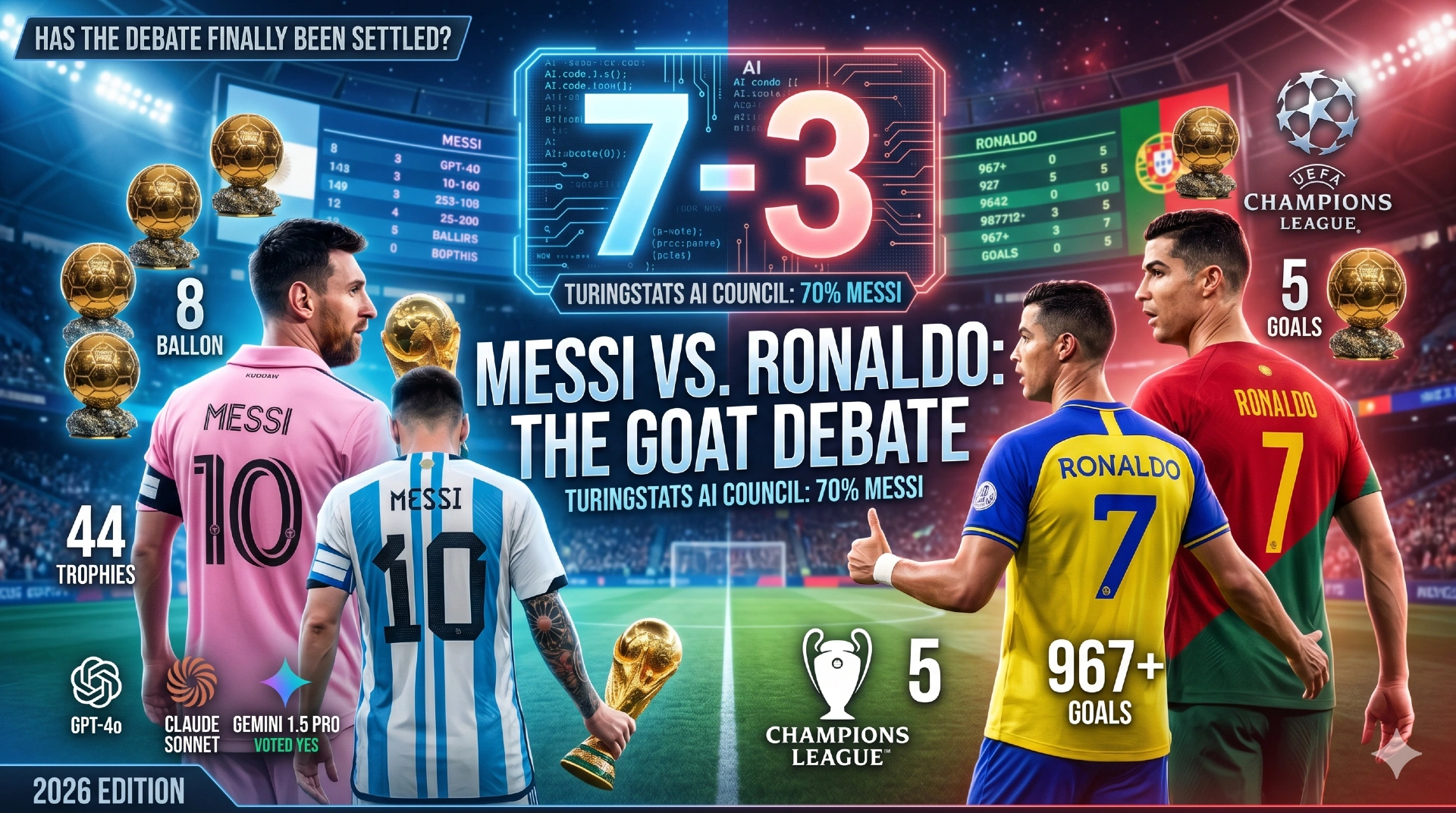
Seven of ten leading AI models now agree: Lionel Messi has won the GOAT debate. But three don't — and their arguments might surprise you. We break down the data, the drama, and the one question that refuses to die.
Messi vs. Ronaldo: Has the GOAT Debate Finally Been Settled — Or Is This Football's Greatest Illusion?
It is the argument that has split locker rooms, divided dinner tables, and fueled more online wars than any political debate of the last two decades. Lionel Messi or Cristiano Ronaldo — who is the Greatest of All Time? For years, the question felt unanswerable by design, a delicious paradox kept alive by two men who seemed to raise their game every time the other did something extraordinary. But as of 2025, something has shifted. The consensus — among analysts, coaches, legends, and even artificial intelligence — is tilting decisively in one direction. And that fact alone is causing a whole new kind of drama.
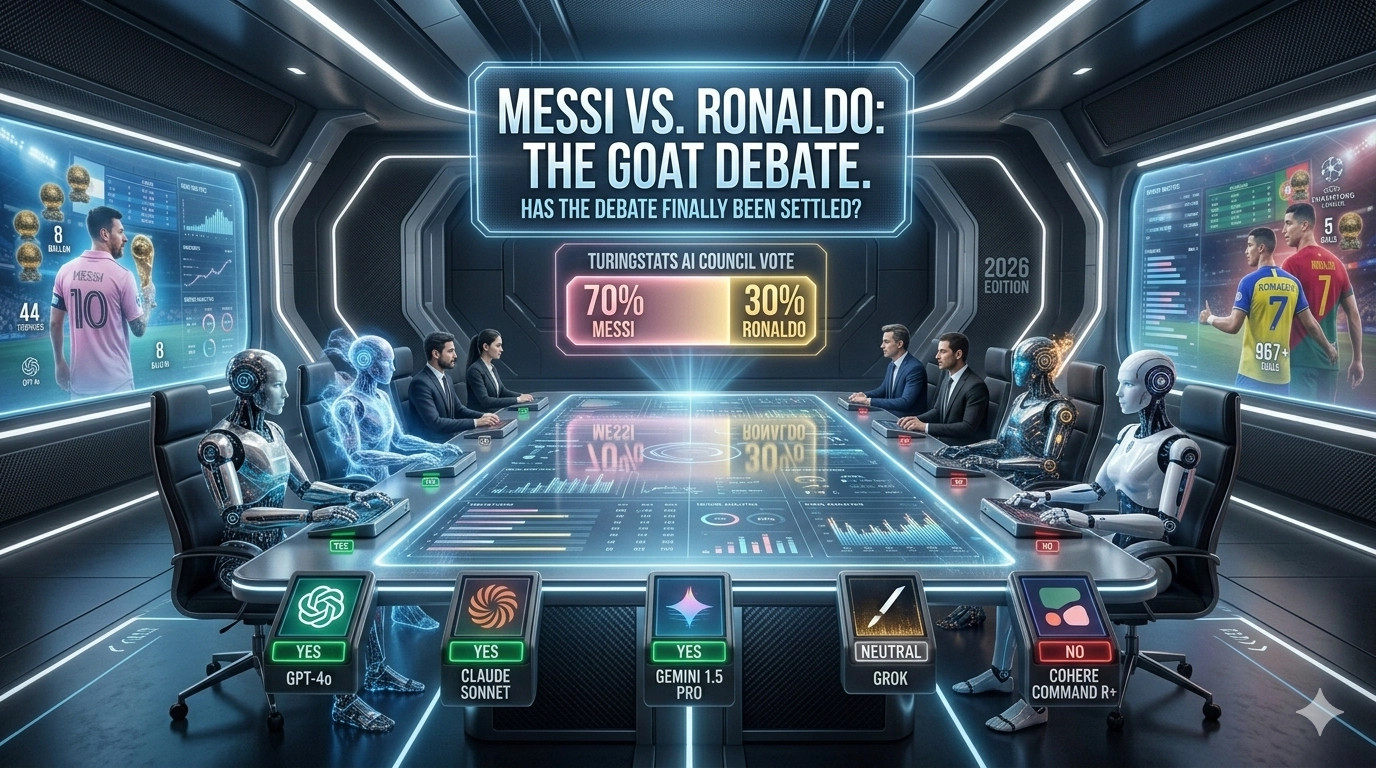
The Verdict from the Machine: 7-3 in Favor of Messi
When TuringStats put the question — "Has Messi definitively won the GOAT debate against Ronaldo?" — to a council of ten leading AI models, the result was striking: seven said yes, three said no. This wasn't a chatbot giving a diplomatic non-answer. These were sophisticated large language models — GPT-4o, Claude Sonnet, Gemini 1.5 Pro, Mistral Large, DeepSeek Chat, Qwen 2.5, MiMo, Llama, Cohere Command R+, and Grok — trained on billions of data points, sports analytics, media consensus, and decades of football history. Their collective judgment carries real analytical weight.
GPT-4o concluded that Messi's "versatility, playmaking ability, and numerous Ballon d'Or awards contribute to his legendary status," while his 2022 World Cup win "added a significant accolade that many considered lacking." Claude Sonnet went further, declaring that the World Cup victory "removed the last credible argument Ronaldo supporters had" and that the debate has "shifted decisively toward Messi as the superior footballer." Gemini 1.5 Pro was bluntest of all: Messi now holds "untouchable status."
But the three dissenting AIs — Llama 3.1, Cohere Command R+, and Grok — offered arguments that deserve serious consideration. Grok, in particular, pointed to Ronaldo's "five Champions League titles, superior longevity in top leagues, and unmatched goal tallies" as proof that the debate "simply does not exist yet" for millions of supporters who prioritize different metrics. The machines don't agree. Neither do we. And that's precisely why this conversation is still alive.
The Numbers That Define Two Legends
Before we argue about greatness, let's establish what greatness looks like on paper. As of mid-2025, Lionel Messi has accumulated over 896 career goals across 1,136 games, contributing 405 assists — giving him over 1,300 direct goal contributions. He has won 8 Ballon d'Or awards (to Ronaldo's 5), 44 trophies across club and country, and 209 individual awards throughout his career. He holds the all-time scoring record for Argentina with 116 goals and 61 assists, and scored 91 goals in a single calendar year for Barcelona — a Guinness World Record. In 2025 alone, he recorded 46 goals and 28 assists in just 54 games while playing in MLS with Inter Miami, earning the Landon Donovan MLS MVP for the second consecutive year.
Cristiano Ronaldo's CV is no less staggering. He has scored approximately 950+ career goals across all competitions — arguably more in raw numbers than Messi — including 140 goals in the UEFA Champions League alone, a record that may never be broken. He has won 5 Ballon d'Or awards, 5 Champions League titles, and holds the record for most international goals ever scored with 135 goals for Portugal. In the 2025-26 Saudi Pro League season, even at 40+ years old, he has managed 28 goals in 30 appearances — a pace that would be extraordinary for any player half his age. According to UEFA, he also holds records for most UEFA club competition appearances (197) and most goals in the European Championship (14).
So who wins on stats? The answer depends entirely on what you value — and that's where the real war begins.
The World Cup Argument: The Trophy That Changed Everything
For a decade, the most powerful weapon in Ronaldo's arsenal wasn't a goal or a trophy — it was an absence. Messi, despite being arguably the most gifted footballer ever to lace up boots, had never won a FIFA World Cup. He had reached the final in 2014 and lost. He had been knocked out early in 2018. For Ronaldo supporters, this was the definitive proof that individual genius could not make a team champion — and that Ronaldo's trophy-per-season efficiency at club level told the truer story of a winner.
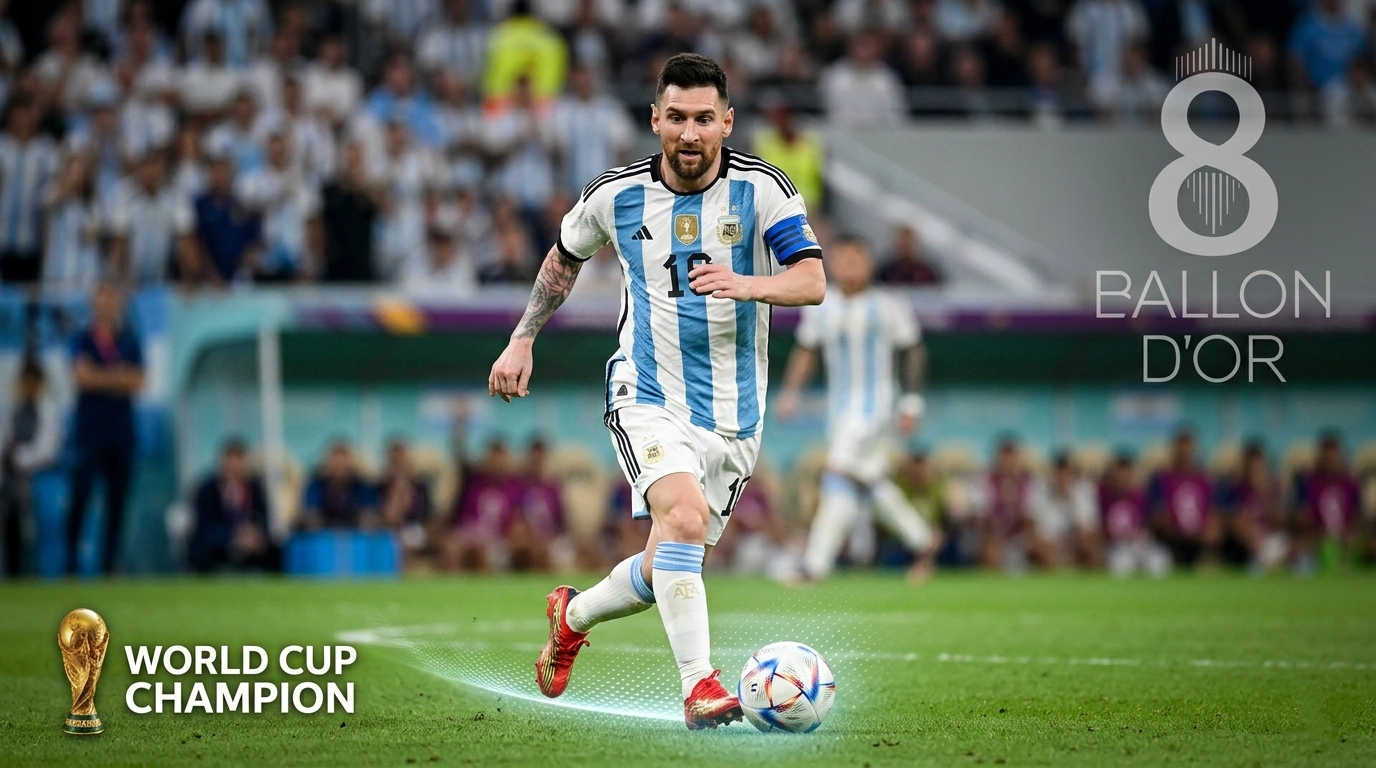
Then came Qatar 2022. Messi, at 35 years old, delivered what many are calling the greatest individual World Cup performance in the history of the tournament. He scored 7 goals, contributed 3 assists, won the Golden Boot, and lifted the trophy after a penalty shootout finale against France that had a billion people on the edge of their seats. The performance in the final — where he scored twice, including a sublime chip — was nothing short of a masterpiece under the most intense pressure imaginable. When he finally raised the golden trophy, it felt like football itself had exhaled.
The significance cannot be overstated. Before 2022, every serious football analyst would note that Messi had never won the World Cup as a caveat. After 2022, that caveat no longer exists. He has now done everything — won every major trophy available to a footballer, at both club and international level. Ronaldo, despite five Champions League titles, has never reached the final of a World Cup. His best international result remains Euro 2016, won in a tournament where Portugal played conservatively and he himself was injured in the final.
Why Ronaldo's Camp Will Never Surrender — And Shouldn't
Here is where the Ronaldo faithful make their most compelling case, and it deserves a fair hearing.
Cristiano Ronaldo's career longevity is genuinely unprecedented at elite level. While Messi relocated to Inter Miami in MLS — a league widely considered to be of significantly lower quality than Europe's top five — Ronaldo continued competing in the Saudi Pro League, which while not the Champions League, features far more physical intensity and competitive depth than MLS. At 40 years old, he is still scoring 30+ goals per season. This is not normal. This is supernatural.
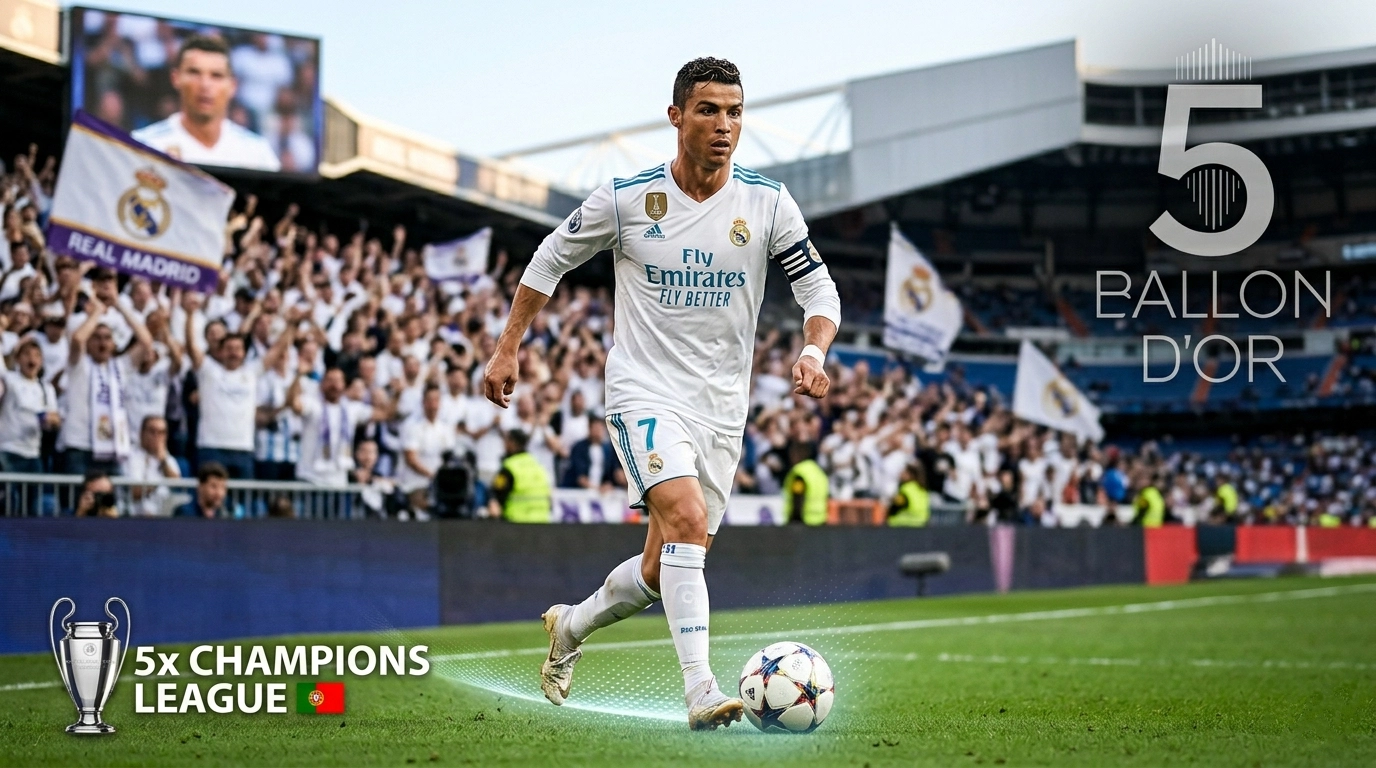
Then there is the Champions League. Five titles. Manchester United (2008), Real Madrid (2014, 2016, 2017, 2018) — including an unprecedented three consecutive trophies with Los Blancos. 140 goals in Europe's elite competition. These are achievements in the sport's most prestigious club tournament that Messi — despite his brilliance — simply cannot match. Messi won the Champions League four times with Barcelona, but his record in the knockout stages against top clubs in the later years was a source of persistent criticism.
And consider the sheer diversity of Ronaldo's conquest. He dominated in England (Manchester United), Spain (Real Madrid), and Italy (Juventus) — adapting his game, his body, and his mentality to succeed in three of the world's four most competitive leagues. Messi, for all his unparalleled talent, spent the vast majority of his elite years in Spain. His time at PSG was widely considered a disappointment. Ronaldo's chameleon-like ability to reinvent himself and dominate in multiple environments is a distinct mark of greatness that the numbers alone don't fully capture.
Style vs. Substance: The Aesthetic Dimension of the Debate
One of the most fascinating dimensions of the Messi-Ronaldo debate is that it isn't purely about trophies or statistics — it's about footballing philosophy. What does it mean to be great at football?
Messi represents what many purists consider the game's highest expression: a player who makes teammates better, who sees angles no one else sees, who dribbles through crowds as if physics doesn't apply to him, and who creates as much as he scores. His style is organic, intuitive, almost improvisational — he looks like someone who plays football the way the sport was dreamed up in a child's imagination. Claude Sonnet noted that his "visionary, creative, and unreplicable" style "represents a higher footballing ceiling." The word unreplicable is key. No coaching manual can produce another Messi. He is a one-in-a-century football miracle.
Ronaldo, by contrast, is the supreme product of will. He arrived at Manchester United as a talented but raw teenager and remade himself through obsessive training into arguably the most physically complete footballer ever produced. His athleticism — the leap, the sprint, the power, the heading ability — is at a level that defied what anyone thought humanly possible in the sport. He became great not by being born Messi, but by refusing to accept that anyone could outwork him. That story resonates differently, and for many fans, more deeply.
What AI Predicts About Their Legacies: 10 Years From Now
This is where the conversation takes an interesting turn into forecasting territory. If AI models were asked today how history will remember these two players a decade from now, the prediction leans heavily toward Messi achieving a Leonardo da Vinci-style mythological status — the player who redefined what the sport could look like at its highest level. The World Cup victory, combined with his record 8 Ballon d'Or hauls, his Copa America titles, and his Barcelona golden era, creates a résumé that is near-impossible to challenge on any front.
But multiple AI models, including Grok and Llama, caution against premature canonization. Football culture in different regions of the world — Africa, Asia, parts of Europe — has historically favored Ronaldo's power-based, athletic, goal-centric style. In terms of global commercial reach, shirt sales, social media following (Ronaldo holds the record for most Instagram followers of any person on Earth at over 650 million), and mainstream recognition outside traditional football markets, Ronaldo remains the more recognizable and marketable figure. Legacy is not purely a sporting metric. It is also a cultural one.
Grok's dissent is particularly thought-provoking: "Definitive closure requires near-universal consensus that simply does not exist yet." Even among the ten AI models — systems trained to aggregate human knowledge and judgment — three withheld their verdict. If the machines can't agree, perhaps the humans never will either.
The Psychological Warfare: Two Men Who Made Each Other Greater
One of the most underappreciated aspects of this rivalry is how profoundly each player has elevated the other. Between 2008 and 2019, Messi and Ronaldo shared 11 of 12 Ballon d'Or awards between them. During the years they competed directly in La Clásico — the Barcelona vs. Real Madrid fixture that became the most watched club game on the planet — both men delivered performances of almost superhuman quality on a routine basis. The pressure of having the best player alive in the opposing dugout drove each of them to heights they might not have reached alone.
Ex-Barcelona manager Pep Guardiola, who coached Messi during the most dominant period in the club's history, has said that Messi is "the best player I have ever seen, without question." Former Real Madrid manager Jose Mourinho called Ronaldo "unique in the history of world football." Former players like Xavi Hernandez and Andrés Iniesta have come down firmly on the Messi side. Legends from Brazil — Pelé before his passing, Ronaldo Nazário, Ronaldinho — have widely acknowledged Messi as the greatest. Diego Maradona, himself the subject of a parallel GOAT debate, went on record saying Messi was his successor.
From the Ronaldo camp: Zinedine Zidane, who coached him to three Champions League titles, has praised Ronaldo's competitive spirit as unmatched. Sir Alex Ferguson, the manager who first handed him a stage at Old Trafford, called him "one of the most exciting young players I have ever seen" and later acknowledged his development into a generational talent. These are not lightweight endorsements.
The 2026 World Cup: One Final Chapter?
As of June 2026, Lionel Messi is deep in Argentina's World Cup qualifying campaign ahead of the 2026 tournament — which will be co-hosted by the United States, Canada, and Mexico. He has scored 12 goals in 14 qualifying games, putting him joint-second among all scorers, plus 8 assists. At 38 years old, Messi is defying the laws of football biology, and the question now is whether he will compete in — and potentially win — a second World Cup. If he does, the debate doesn't just end. It gets erased.
Ronaldo, at 40+, did not qualify Portugal for the 2026 World Cup through automatic means in some scenarios, though Portugal are among the contenders. Whether he participates in what would be his final World Cup — and whether he can make a meaningful impact — adds another layer of drama to a rivalry that refuses to produce a clean ending.
The Verdict: Is the Debate Settled?
Here is the honest answer: mostly yes, but not completely — and perhaps that's the point.
By the most widely accepted metrics of football achievement — Ballon d'Or count (8 vs. 5), World Cup medals (1 vs. 0), Copa América titles, creative statistics, and the consensus of football's greatest minds — Lionel Messi holds the stronger hand. Seven of ten AI models, trained on the accumulated knowledge of the football world, agree. The center of gravity of informed opinion has shifted. Messi is, by most measures, the Greatest of All Time.
But Cristiano Ronaldo's argument is not dead. His Champions League record is unmatched. His longevity is supernatural. His impact across multiple countries and cultures is undeniable. His goal-scoring records — 140 in the Champions League, 135 for Portugal, 950+ in his career — speak to a consistency and ruthlessness that are, in their own right, a form of greatness. And crucially, the football you love — physical, direct, and goal-centric versus creative, fluid, and holistic — determines which kind of greatness you value more.
Perhaps the deepest truth the TuringStats AI council revealed isn't in the 7-3 vote. It's in the fact that three of the most sophisticated analytical systems in the world still refused to call it. The GOAT debate, in its truest form, is less about football statistics and more about what we believe greatness means — and that is a question that AI, coaches, and fans will be arguing about for generations to come.
The only certain thing? We were extraordinarily lucky to watch both of them.
What Do You Think?
The AI council has cast its vote: 7-3 for Messi. But the most important vote is yours. Does Messi's World Cup winner's medal close the debate forever — or does Ronaldo's Champions League dominance and unbreakable longevity keep the argument alive? Tell us in the comments, and try the TuringStats AI council yourself to see how ten AI models reason through the question in real time.