Insights
AI Forecast: Who Will Win the UEFA Champions League This Season?
A data-driven outlook on the top Champions League contenders using aggregated AI predictions, tactical profiles, and performance indicators.
As the UEFA Champions League enters its decisive phase, the question dominating discussion is simple: who will lift the trophy this year? While traditional punditry focuses on form, injuries, and experience, AI-based analysis offers a broader perspective by combining historical data, tactical patterns, and probabilistic modeling.
This article presents a data-driven outlook on the leading contenders, synthesizing insights from multiple AI models and performance indicators.
The current landscape has not produced a single overwhelming favorite. Instead, several elite teams remain in contention, each with distinct strengths and vulnerabilities. Among them, a few clubs consistently emerge as frontrunners in AI projections.
Manchester City remain the most statistically dominant team in Europe. Their strengths include high possession control with vertical penetration, exceptional squad depth, and tactical adaptability under Pep Guardiola. AI systems consistently rank City highly due to their ability to generate strong expected goals (xG) while limiting opponent chances.
Still, knockout football introduces volatility. Even dominant teams can be undone by a single tactical mismatch or one moment of individual brilliance.
Real Madrid represent a different kind of threat. Their edge is not only statistical but experiential: proven performance in high-pressure knockout games, mental resilience in critical moments, and an elite ability to convert limited chances. Historically, Madrid can outperform predictive baselines in scenarios that are difficult to quantify, such as momentum shifts and game-state management.
Bayern Munich combine physical intensity with attacking efficiency. Their profile features direct high-tempo transitions, strong pressing structure, and consistent goal output. AI projections place Bayern among the top contenders, especially against teams that struggle under pressure. Their core risk remains defensive transition exposure against technically elite opponents.
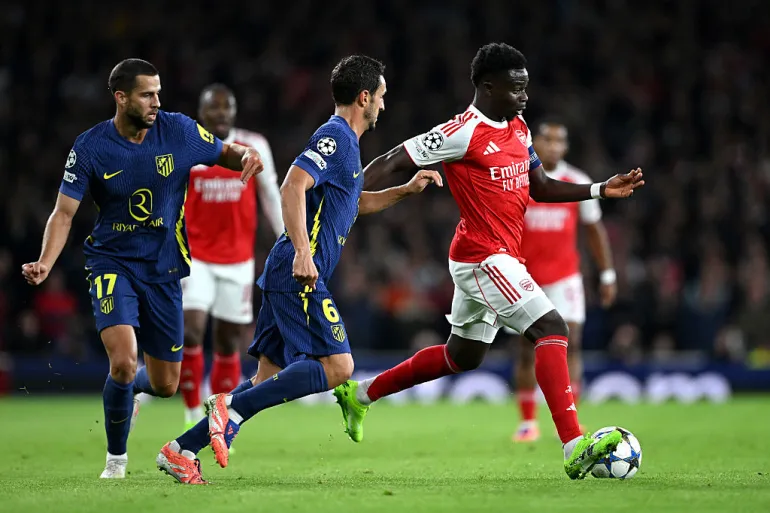
Arsenal have emerged as one of Europe’s most improved teams under Mikel Arteta. Their strengths include structured positional play, high pressing, fast ball recovery, and balanced attacking distribution. From a data perspective, Arsenal score well in both chance creation and defensive stability, though their relative lack of deep Champions League knockout experience is still a variable.
Atletico Madrid remain one of Europe’s most tactically disciplined sides. Their approach emphasizes defensive compactness, low-risk game management, and efficiency in tight matches. AI models often assign Atletico lower win probability in open, high-tempo games but stronger chances in close, low-scoring two-legged ties.
Aggregating outputs from multiple AI systems, the estimated probabilities for winning the tournament are: Manchester City 30%, Real Madrid 25%, Bayern Munich 18%, Arsenal 15%, and Atletico Madrid 12%. These figures reflect consensus tendencies, not certainties, and the relatively narrow spread highlights how competitive this season remains.
Key deciding factors will include tactical flexibility across two-legged ties, squad depth under fixture congestion, and game-state control when leading, trailing, or level. Marginal moments such as set pieces, individual errors, and flashes of brilliance can outweigh broader statistical trends in knockout football.
Final prediction: based on current AI projections and performance indicators, Manchester City remain the most likely winner of this season’s UEFA Champions League. Their combination of tactical control, squad quality, and sustained statistical superiority gives them a measurable edge over the field.
However, the margin is not decisive. Real Madrid in particular remain a persistent outlier, capable of defying probabilistic expectations in high-stakes matches.
Conclusion: the 2026 Champions League title race is defined by balance rather than dominance. While AI models point toward Manchester City as the leading candidate, knockout football ensures uncertainty remains high. In this environment, even advanced predictive systems offer probabilities, not guarantees.
This analysis is based on aggregated AI predictions and statistical modeling. It is intended for informational purposes only.